Lou Salomé

She rejected Nietzsche twice and he had a breakdown. She seduced Rilke and made him a poet. Then she became Freud’s colleague. All while “married.”
Rome, 1882. Lou Salomé was 21 years old and already considered one of the most unconventional women in Europe. She wasn’t dangerous because of wealth or political power. She was dangerous because she was intelligent, independent, and completely unwilling to live according to society’s rules.
Friedrich Nietzsche fell in love with her almost immediately. So did his close friend, philosopher Paul Rée.

Lou Salome 1897
Lou’s response shocked both men. Instead of choosing either of them, she proposed that the three live together in what she called a “free community of minds.” No marriage. No ownership. Just intellectual companionship, conversation, books, and philosophy.
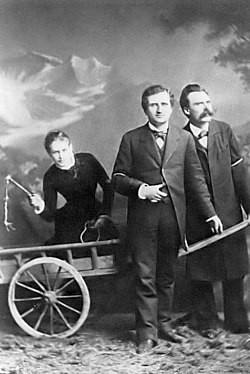
To make her point clear, she arranged a now-infamous photograph: Lou sitting in a cart holding a whip while Nietzsche and Rée stood harnessed like horses pulling her.
The image scandalised Europe.
But the arrangement collapsed because both men were deeply in love with her, and Nietzsche could not handle rejection. He proposed marriage once. Lou refused. He proposed again. She refused again.
His letters became increasingly desperate. Eventually he admitted he felt himself losing his sanity.
After Lou rejected him for the final time, Nietzsche withdrew into isolation and depression. Soon afterward, he wrote *Thus Spoke Zarathustra*, the work many later connected to the emotional collapse caused by losing her.
Years later, when Nietzsche’s mental state completely deteriorated, critics blamed Lou and accused her of destroying him.
She ignored them and continued with her life.
In 1887, Lou married Friedrich Carl Andreas, a scholar of Persian studies. But the marriage was highly unusual. She only agreed after Andreas threatened to k*ll himself, and even then she imposed strict conditions.
The marriage would never be physical.
They lived separately for decades while remaining legally husband and wife. Lou kept her independence completely intact.
At the same time, she continued writing novels, essays, and philosophical works in intellectual circles dominated almost entirely by men.
Then, in 1897, she met a young poet named Rainer Maria Rilke.
Lou was 36 years old. Rilke was 22 and still unknown.
Their relationship lasted years and transformed his life. Lou guided his writing, criticized his work, introduced him to Russian literature and spirituality, and even changed his name from René to Rainer because she believed it sounded stronger.
Rilke became emotionally devoted to her.
But Lou always kept control of the relationship. When he became too dependent on her emotionally, she ended the affair.
Rilke spent the rest of his life writing under her influence.
Then, at age 50, Lou entered another world controlled by men: psychoanalysis.
She attended Sigmund Freud’s lectures, and Freud quickly recognized her intellect. Unlike many women around him, Lou was treated as an equal rather than an assistant or patient.
She became Freud’s colleague.
Lou opened her own psychoanalytic practice and wrote openly about female sexuality, desire, and emotional independence at a time when society barely allowed women to discuss such subjects publicly.
Even Freud respected her enough to listen when she challenged his ideas.
Lou Andreas-Salomé spent her entire life refusing to become what society expected. She rejected traditional marriage, moved freely through philosophy and literature, and forced some of Europe’s greatest minds to accept her on equal terms.
People called her manipulative, cold, and dangerous.
But perhaps what truly frightened them was much simpler:
She lived exactly the way she wanted and never apologized for it.
No comments:
Post a Comment