Days Have Gone By · John Fahey
Days Have Gone By, Vol. 6 ℗ 1967 Takoma Records
more guitar from John Fahey
Days Have Gone By · John Fahey
Days Have Gone By, Vol. 6 ℗ 1967 Takoma Records
In Christ There Is No East Or West
John Fahey
which is weird coming from a confirmed atheist but hey , , , , , . . . ... we knew he was interesting!?


The new Uncut Magazine is now on sale! Talking Heads! Bob Marley! Kim Gordon! The Waterboys! Julia Holter! Phosphorescent! Rosali! John Fahey! Michael Moorcock! DION! Mud! A free, 15-track new music CD!
More here: https://bit.ly/UncutTalkingHeads

there’s lots of banter and tuning which frankly I could do without . . . . . finding out negative views of musicians is always a problem and referring to a woman as "a dog" is not helpful!
but still the quality of the recording is great and the guitar legend is on form here . . . . . . .
Live at Amazingrace (at The Main), Evanston, IL; August 16, 1975. Very good soundboard.
+ + + + +
Track 01. banter, tuning 2:44
Track 02. Some Summer Day/Candy Man/Stomping Tonight On The Pennsylvania-Alabama Border/Christ’s Saints Of God Fantasy/In Christ There Is No East Or West/Beverly 23:39
Track 03. tuning 2:42
Track 04. Owchita/The Dance Of The Inhabitants Of The Palace Of King Philip XIV Of Spain 17:45
Track 05. tuning 0:16
Track 06. Gaucho (first time ever played publicly) (banter) 5:05
Track 07. break, tuning 5:46
Track 08. On The Sunny Side Of The Ocean/Spanish Two-Step/Lion 15:27
Track 09. tuning 1:14
Track 10. The Revolt Of The Dyke Brigade/Requiem For Mississippi John Hurt 9:09
84 mins
One of the most extraordinary things about Big O (despite the tirades of filth from largely US trolls with their racist sexist school boy filth) is the amazing eclectic range of postings and recently there is no exception with this item here. A favourite and fascinating guitar savant ( I would maintain) in John Fahey the extraordinarily gifted and unique self taught player and composer of guitar pieces without equal
+ + + + +
Disc 1
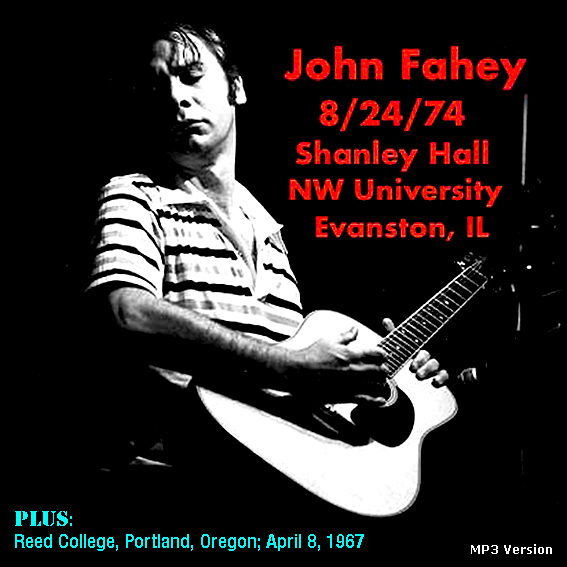
Amazingrace Coffeehouse, Shanley Hall, Northwestern University, Evanston, IL; August 24, 1974Thanks to OldNeumanntapr and frenfri for sharing the show at Dime.
Track 01. Thus Krishna On The Battlefield 10:10
Track 02. Fare Forward Voyagers 24:08
Track 03. Owchita/Dance Of The Inhabitants Of The Palace Of King Philip XIV Of Spain 19:00
Track 04. On The Sunny Side of The Ocean (false start) 0:19
Track 05. On The Sunny Side of The Ocean/Spanish Two-Step 9:45
64 minsBonus:
Track 06. The Revolt Of The Dyke Brigade/Requiem For Mississippi John Hurt 7:05
Live at the Great American Music Hall; San Francisco, CA; October 10, 1974 (soundboard)Disc 2
Reed College, Portland, Oregon; April 8, 1967
Track 01. St Louis Blues 2:50
Track 02. The Great San Bernadino Birthday Party Part 1 2:22
Track 03. The Great San Bernadino Birthday Party Part 2 5:00
Track 04. Requiem for Russell Blaine Cooper Part 1 2:20
Track 05. Requiem for Russell Blaine Cooper Part 2 5:02
Track 06. Red Pony (Wine & Roses) 4:48
Track 07. On the Banks of the Owchita 5:06
Track 08. When the Catfish is In Bloom 6:45
Track 09. Dance Of The Inhabitants Of The Palace Of King Philip Of Spain 5:10
Track 10. In Christ There is No East Or West 3:10
We were talking about John Fahey and he seems to crop up time after time and somehow this time of year especially too. So go check this over at Floppy Boot Stomp (where else?)


As the Turkey-fare winds down and the boxes of Christmas decor make their way from the basement, a transition is needed. Ringing in the holiday season in subtlety requires a look no further than America’s finest composer and most innovative maestro of steel string. With a discography expanding beyond 40 titles, it’s possible to overlook the holiday offerings among masterworks like Fare Forward Voyagers, The Yellow Princess, and those first five Takoma releases. Smack dab in the middle of John Fahey’s first decade shifting around the tectonic plates of traditional music came The New Possibility.
Prior to this moment, a collection of holiday tunes assembled specifically for the steel string acoustic guitar was unheard of. The holiday-inclined were limited to the efforts of crooners or classic orchestral renderings of “God Rest Ye Merry Gentlemen” and “Joy to the World.” Over the course of his career, Fahey would return to the wealth of holiday music to assemble some six-string arrangements to keep the merriment going, while simultaneously conducting experiments on the construction of the tunes themselves; the solo guitar will always bring out the essential essence of a piece. As the years went on, the originality and quality would deteriorate—it appears that the constant reissuing and reorganizing of these collections became a way for the notoriously destitute genius to attain some sort of income in a culture that wasn’t ready to recognize the magnitude of his artistic contributions. With The New Possibility and 1975’s Christmas with John Fahey, Vol. II, however, St. John was christened. Fahey would be entered into those holly-decked halls of holiday lore as the albums went on to become his most commercially successful releases. It was finally time for the luddites, weirdos, and eccentrics alike to have their moment in the hearth’s glow.
Being the most influential figure in revolutionizing the acoustic guitar, there is something unnerving in the knowledge that adapting well-known festive numbers would be Fahey’s biggest communion with the general public. But like everything else touched over his lifetime, the guitarist imbues an esoteric mastery over the tunes compiled. With a technique so inherently his, the only option is to remake them in his own gnarled image. Over both volumes, Fahey takes beloved Christmas tales and converts them into something one could imagine coming from a reverb drenched cathedral in the 16th century (and even more far out—sounding like something smack dab in the mountains of Appalachia). “What Child is This” comes through painfully slow. Like a distorted music box that’s built up centuries of corrosion on its gears. Immediately followed by the jauntiest “Hark, The Herald Angels Sing” ever recorded (you could travel across the continent to the pulse of that bassline), Fahey ensures that listeners are not lulled off to a Victorian dreamland too soon. The “Auld Lang Syne” is played with such conviction that even the harshest Englishman would be brought to tears as the neeps and tatties are wheeled out for Burn’s Night. The New Possibility, while having the better production for a hauntingly Dickensian Christmas, maintains the dirge-like tempo for (mostly) the entirety of its duration. Vol II breathes more life into the affair. The numbers are quicker, the songs equally familiar, and the production is more jovial than its predecessor’s melancholy. Most important though—the fantasies remain.
Of course, the fantasies. Exactly what fucking Christmas going on here is unintelligible, but The New Possibility’s “Christ’s Saints of God Fantasy” and both parts of Vol. II’s “Christmas Fantasy” are the absolute showstoppers. The imaginary Christmas summed up in the classics is far from the experience we all have. It is with these swirling odysseys of fingerpicked spontaneity that we find holiday reality. A season that blasts past filled with imperfections, highs, lows, and surprises. Here, Fahey also exposes the listener to his Primitivism ethos. The improvised marvel of the soloist, founded on American Blues, but navigated with all ears toward the Avant Garde. Under the guise of a harmless Christmas record (his bestselling LP at that), Fahey found a way to break through to the mainstream. Under these pretenses, a hidden treatise on free music of the rootsy-est order was delivered to an unsuspecting public. And so spread the gospel of St. John’s Christmas Soli. | j rooney


AD have posted a great link to a YouTube concert of John Fahey the mercurial and uniquely gifted guitarist, they say:
John Fahey: resurrected once again. This 1967 soundboard recording, discovered among lost readings by beatnik poets Allen Ginsberg and Gary Snyder, is the oldest recorded solo concert from the acoustic guitar innovator.