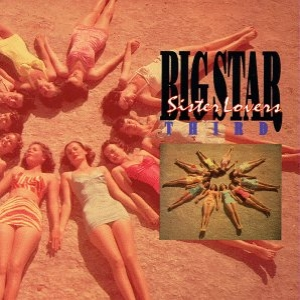
"This might just be my favorite Big Star song, kinda halfway between Sister Lovers’ falling to pieces vibe, and the hard pop of the first two records.” Guess I’m Dumb
And girl, if you’re listening I’m sorry, I can’t help it
Now is this problematic? You write a song about first love and adolescent falling in love and yet somehow you are a grown man writing about a thirteen year old!?!??? Great song mind . . . . .
"Thirteen" is a song by American rock bandBig Star.Rolling Stone describes it "one of rock's most beautiful celebrations of adolescence", and rated it #396 on their list of the 500 greatest songs of all time. It was written by Alex Chilton and Chris Bell.
The name of the album was #1 Record, which was bitterly ironic, as it ended up selling under 10,000 copies upon its initial release in 1972 (the name of the band also proved to be an unfortunate misnomer, because outside of critics and other musicians, they remained virtually anonymous during their brief time together).
Bell and Chilton wanted to emulate the Lennon/McCartney formula as much as they could, so they shared credit on many of their songs even though there was in fact little writing collaboration between the two. “Thirteen" was in fact entirely Chilton’s creation, and he also delivers the aching vocal that vacillates between hope and heartache and that many cover versions have tried to emulate but never quite matched.
The yearning acoustic ballad focuses on an age that is somewhat underrepresented in pop and rock music. Chilton found that bittersweet spot when innocence still lingers but more complicated emotions start to work their way into the picture.
Over tender guitars, he begins with a question that thirteen-year-old boys have been asking thirteen-year-old girls for generations: “Won’t you let me walk you home from school?” “Won’t you let me meet you at the pool?” he follows, again treading lightly so as not to scare her away. He eventually suggests a date at the dance on Friday; “And I’ll take you,” Chilton delicately sings, as if anything more forceful than a gentle plea will destroy his chances.
In the second verse, the narrator for the first time reveals an obstacle blocking the path to this girl for whom he is clearly falling hard: “Won’t you tell your Dad get off my back?” he asks her. His response to the doubting father is brilliant: “Tell him what we said about ‘Paint It Black.’” By drawing a parallel between his own musical tastes and that of the father, he’s hoping to show that he’ s not just some punk kid with bad intentions.
The final verse finds him struggling as she remains seemingly unknowable (“Won’t you tell me what you’re thinking of?”) resulting in his sweet but awkward follow up (“Would you be an outlaw for my love?”) His final lines redeem him in terms of his integrity and honor, even as they suggest that he’ s losing his opportunity with her in the process: “If it’ s no then I can go/ I won’ t make you.” The final “Ooo-hoo” that Chilton utters is a real killer, tinged as it is with the sting of implied refusal.
Over the decades there have been some fine cover versions of this classic, with brilliant and diverse artists like Garbage, Wilco, and Elliott Smith taking their turns, among many others. But they’d likely all agree they were playing for second behind Chilton’s one-of-a-kind, haunting performance. “Thirteen” is as good as it gets for those looking to relive that moment when life is still rife with possibilities but love seems stubbornly impossible.
Music critic Simon Robinson rates it as Big Star's best song and one of the most important of 1972, praising the "catchy melody and jangly guitars that perfectly capture the carefree and optimistic spirit of youth" and the "simple yet poignant" lyrics that evoke the "experience of teenage romance and heartbreak."
Eurythmics - Belinda (with Dave playing bass and do you recognise the drummer . . . ?)
Play until the end . . . . . .and at THAT moment everyone fell in love with her!
Never Gonna Cry Again . . . . . .
(recognise anyone else!) Holgar Czukay on French Horn, with Clem Burke on Drums)
We don’t think so much about birthdays this time of year but what about this . . . . . . Christmas Day marks the Birthday of perhaps our finest ever pop voice!
Who IS this bonnie lass?
Of course its legendary Eurythmics ad solo virtuoso
ANNIE LENNOX
Ann "Annie" Lennox (born 25 December 1954)
and of course today would have been Alex Chilton’s birthday
The Boxtops - The Letter (bought when it came out)
and finally . . . . . . . . more Annie
Annie [Nightingale] introduces the whole Shebang! (in case you don’t believe me!)
worth listening to again? I think so!
Annie Lennox- lead vocal and multi instrumentaist (flute here)
Dave Stewart (writer and bass player)
Roger Pomphrey - lead guitar
Clem Burke - drums
Penny Tobin - keyboard and backing vocals (cruelly underrated and under exposed. If Annie chose her as backing vocals she wasn’t messing about she chose the best to back her, like Eddi Reader )
Tim Wheater - flautist
Holgar Czukay - French Horn
I like her - can you tell?
First time I saw the band and Annie sing . . . . . . . . . hook line and sinker!
A slow beautiful sound for the cover of Jumpin’ Jack Flash. By Alex Chilton from Chilton’s Free Agian: The “1970” sessions. Recorded while he was constrained to the Box Tops and before he joined Big Star.
By Marcelo Costa - Alex with Big Star at Hyde Park
Now this is interesting and I only just spotted this but Aquarium Drunkard have posted a lovely and fascinating article on Alex Chilton. Now in terms of singles bought when they came (a current thread for posting music I have used for the past year or so) I bought the Box Tops' 'The Letter' when it came out and we adored it and played it to death. I was still at school but it was never off the youth club turntable for an age. I loved the blue eyed soul sound and Alex's voice belied his callow years.
To know that he went on to become an enigma and the brains behind Big Star (alongside the tragic Chris Bell whose band it had been, killed in a car accident at 27 - yes, that age again 27 ) came to us Brits really slowly, we had thought the Box Tops a one hit wonder but this article shows a searchlight onto Chilton's ambitions, his tastes and his breadth of interest from the blue eyed soul of pop, to the later indie band retro sound beloved of REM and others, to an abiding interest and a serious one in jazz standards. Check it out here . . . . . Frame For The Blues: The Powerful Ease of Alex Chilton - Aquarium Drunkard
Once more a classic pop single of all time and whilst it could have been a one hit wonder the legendary Alex Chilton and his band Big Star went on to an almost entirely different sounding success and a more traditionally pop/rock format songbook. Chilton also seemingly simultaneously produced and developed bands like Tav Falco's Panther Burns and the truly extraordinary pre-punk The Cramps. 'The Letter' by Chilton's Box-Tops is one of those singles that caught the zeitgeist and took almost all of us on a little story book journey. Again I don't know anyone here who didn't buy it!
On this day in music history: September 23, 1967 - “The Letter” by The Box Tops hits #1 on the Billboard Hot 100 for 4 weeks. Written by Wayne Carson Thompson, it is the debut single and biggest hit for the Memphis, TN quintet fronted by lead singer Alex Chilton. Songwriter Wayne Carson Thompson (“Always On My Mind”) is inspired to write “The Letter” when his father comes up with the lyric “give me a ticket for an aeroplane”. Thompson quickly write the rest of the lyrics and melody around that line. Once the song is complete, Thompson takes it to his friend, producer Chips Moman who also own American Recording Studios in Memphis, TN. Moman in turn tells his songwriting partner Dan Penn about the song. Penn is working with a young rock band featuring a sixteen year old lead vocalist named Alex Chilton. Penn hears the song and decide that it is perfect for his young charges first release. Recorded in the Spring of 1967, the band (with songwriter Thompson also playing guitar on the session) cut the track in about eight hours, recording thirty takes to come up with the final master. For the final touch, producer Dan Penn overdubs the sound of an airplane flying over toward the end of the song. When Moman objects to the addition, Penn threatens to cut up the tape with a razor blade rather than remove the sound effect. Moman allows it to remain on the finished record. At the time the band records the single, they do not have a name. One of the members jokingly suggests that people “send in 50 cents and a box top” with their possible group name. From that, the band are dubbed “The Box Tops”. Released in July of 1967 on Bell Records Mala imprint, “The Letter” quickly becomes a huge hit. Entering the Hot 100 at #85 on August 12, 1967, it leaps to the top of the chart six weeks later. The song is covered by a number of artists including The Arbors, The Ventures and Don Fardon. Joe Cocker has the second most successful recording of the song when his version hits #7 on the Hot 100 in June of 1970. “The Letter” is certified Gold in the US by the RIAA.