I Can See You - by Paddy Summerfield c. 1986
Showing posts with label Jimi Hendrix. Show all posts

Friday, September 18, 2026

Remembering Jimi Hendrix (November 27, 1942 – September 18, 1970) | Don’s Tunes


 May be an image of text that says "Remembering Jimi Hendrix (November 27, 1942 - September 18, 1970)"


"I don't really live on compliments. As a matter of fact, they have a way of distracting me. I know a whole lot of musicians, artists out there who hears the compliments and thinks "wow, I must have been really great" and so they get fat and satisfied and they get lost and forget about their actual talent and start living in another world.
Pretty soon I believe people will have to rely on music to get some kind of peace of mind, or satisfaction, or direction, actually. More so than politics, the big ego scene. You know it's an art of words... Meaning nothing. Therefore you will have to get an earthier substance, like music or the arts."
Dick Cavett interview (1969)
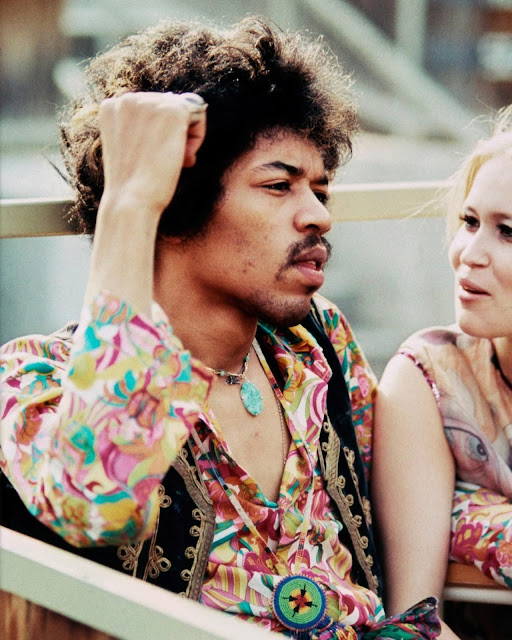
Photo: the legendary Gered Mankowitz

Friday, July 11, 2025

Say What Now? . . . . .

 More fascinating finds from FLOPPY BOOT STOMP / VOODOO WAGON Facebook pages . . . . 


With news that a new King Crimson album is in the works, Fripp's past comments highlight the left-field ideas that make him an original

Ha ha ha ha ha love the comment about Clapton - HILARIOUS! Curiously he doesn’t claim to listen to guitarists and doesn’t care for any. Hendrix not a guitar player? Please explain! 


Thursday, April 03, 2025

Jimi and those military jackets . . . .


In 1966, Hendrix moved to London and fully immersed himself in British fashion. The 1960s counterculture brought out a revival of romantic victorian aesthetics not only in the fashion industry, but in music as well. In 1967, the cover of Sgt. Pepper’s Lonely Hearts Club Band, showcased the Beatles sporting multi-colored, military sergeant’s jackets.

Hendrix looked to the Beatles for inspiration, just like everyone else did, and is later seen wearing a similar coat to the ones they wore on the album cover. This particular coat that Hendrix is wearing is called a ‘Pelisse’ or ‘Hussar’ jacket, ornamented with a fur trim and gold French braiding. He purchased it from a boutique store named “I Was Lord Kitchener’s Valet” on Portobello Road, in Notting Hill. This outfit shows the influence that living in London had on Hendrix’s style. His interest in European military regalia inspired people everywhere to dress like him.(sic)


Source: Vman
Photo: Nico Van der Stam

Monday, March 24, 2025

Jimi and Carmen Borrero 1968


 Jimi Hendrix sits next to Carmen Borrero in a Pool Box seat during afternoon sound check at the Hollywood Bowl, California, September 14, 1968. Photographer: the legendary Ed Caraeff

In the American Tour of 1968, Jimi Hendrix took the opportunity to spend a month in a beautiful house in Los Angeles, which had previously been used by the Rolling Stones. Although the ‘Experinece’ had recording sessions scheduled during this period, it was by far the least intense time in the last two years of Jimi Hendrix’s life. However, there was still time for miraculous episodes, such as the one related to his car. Jimi Hendrix had his Corvette sent to New York, but due to his poor eyesight, he smashed the car on the day it arrived; he later bought another.
During this period of Jimi Hendrix’s daily life, he frequented clubs, and at the Whisky A Go Go, Jimi met an employee who would soon become a part of his love life, a former Playboy Club bunny and a beautiful blonde woman from Puerto Rico, Carmen Borrero.
Soon, Carmen Borrero would start dating Jimi Hendrix, but this didn’t prevent Jimi Hendrix from continuing to be involved with groupies, nor did it prevent Jimi from talking about his great love, Kathy Etchingham. Despite being openly unfaithful to Carmen Borrero, Jimi Hendrix felt intense jealousy towards her, especially when she was with his friend from The Animals, Eric Burdon.
Source: Alexandre G. / Musiclipse


Jimi and Carmen ‘68

and still with us today


Saturday, November 16, 2024

Guitar lick pics bar none - VERNON REID (Living Colour) picks his top guitarists | Floppy Boot Stomp - Voodoo Wagon facebook page

 Speaking of Guitar there’s this from FLOPPY BOOT STOMP/ VOODOO WAGON who posted this on their Facebook page . . . . .worth checking the guy knows his chops!


“The Who, Van Halen – the whole thing where there’s a separate singer from the lead guitar player. That started with Hubert Sumlin and Howlin’ Wolf”: Vernon Reid on the 7 riffs that inspired him, from Hendrix to Chic, Cream, and more” Vernon Reid - Living Colour


Howlin’ Wolf - I Ain’t Superstitious

MAESTRO!
Jimi Hendrix - Power of Soul : Band of Gypsies


Wednesday, November 13, 2024

Jimi’s funeral pallbearers 1st Oct 1970


 Dave Anderson, James Thomas, Steve Phillips, Eddy Howard, Donny Howell, and Herbert Price were pallbearers. All childhood friends apart from Price who was Jimi’s last driver. For some reason I get great comfort from it being a small unostentatious rather typical family funeral and that he was taken to rest by his childhood friends that the family got what THEY wanted and it was all the more respectful for that. Don’t know why it occurred to me today but it did

Rolling Stone account of Jimi’sFuneral in his hometown

Sunday, October 06, 2024

Jeff Beck first sees Jimi Hendrix! | Don’s Tunes


here . . . . .  

Jeff Beck: “I’d like to get back to that Jimi Hendrix Experience type of approach,” he says. “The way that Jimi played, you didn’t miss the keyboards. It was all heavy and powerful. It just suggested power through the drummer, which I like. I love the sound of a big three-piece.” 

"When I saw Jimi, we knew he was going to be trouble, and by ‘we’, I mean me and Eric (Clapton) because Jimmy (Page) wasn’t in the frame at that point.” I saw him at one of his earliest performances in Britain, and it was quite devastating,” he continued, humbly revealing his envy. “He did all the dirty tricks – setting fire to his guitar, doing swoops up and down his neck, all the great showmanship to put the final nail in our coffin. I had the same temperament as Hendrix in terms of ‘I’ll kill you’, but he did in such a good package with beautiful songs. 

I don’t want to say that I knew him well, I don’t think anybody did, but there was a period in London when I went to visit him quite a few times,” Beck added later. “He invited me down to Olympic studios, and I gave him a bottleneck. That’s what he plays on Axis: Bold As Love. We hooked up in New York and played at Steve Paul’s club, The Scene.”

Don's Tunes


Monday, September 30, 2024

Jimi Hendrix - Red House (Live in Sweden 1969)

 guitarists contd., with Jimi hisself!

While Jimi Hendrix is often hailed as “rock’s greatest guitarist,” the music he most closely identified with was the blues. After all, this had been the soundtrack of his youth, the music he heard his paternal grandmother sing and his father play on their record player. “Jimi lived on blues around the house,” Al Hendrix remembered. “I had a lot of records by B.B. King and Louis Jordan and some of the downhome guys like Muddy Waters. Jimi was real excited by B.B. King and Chuck Berry, and he was a fan of Albert King too. He liked all them blues guitarists. He’d try to copy what he’d heard, and he’d make up stuff too.”
Jimi’s account of his musical roots aligned with his father’s: “I was largely influenced by blues when I first started,” he reported in Rolling Stone. “When I first started playing guitar, it was way up in the Northwest, in Seattle, Washington, and they don’t have too many real blues singers up there. The first guitarist I was aware of was Muddy Waters. I heard one of his old records when I was a little boy, and it scared me to death. Wow! What was that all about? It was great.” 

Sunday, September 22, 2024

B.B. King on Jimi Hendrix:


-  Interviewer: How do you rate Jimi as a blues guitarist, let's say along the likes of Albert King, etc.? 

- BB: How to rate them? I'm no good with that, I can just tell you that Jimi Hendrix held his own with anybody... 

-  Interviewer: Was Jimi from the same blues tradition, even though he wasn't born in the South? 

- BB: I don't think it has anything to do with where a person is born... A lot of people play blues who have never been to the South or even have been to the United States... I heard some people in Japan playing blues as well as I've heard... Jimi to me was one the great explorers if you will of the so called Delta blues... Muddy Water was playing when I was ploughing on the plantation... I think when we are thinking in terms of music as a whole, I think that many people just put labels on, thinking that has a lot to do with it, but I disagree, it has to do with the person, the inner soul of the person... 

-  Interviewer: Was there anything in particular you admired in Jimi's playing? 

- BB: Yes. He was Jimi Hendrix! He didn't sound like anybody else but himself. He was like Charlie Parker in his way of playing, he played well, he was a person that made waves. When you heard Jimi Hendrix you knew it was Jimi Hendrix, he introduced himself in his instrument... You know, many radio stations play records and a lot of the times they don't call out the names who you just listened to, but when they play Jimi Hendrix, you don't have to tell me, [you know] it's Jimi Hendrix... 

-  Interviewer: Do you recall the few shows you did with Jimi in the package tours during the 60s? 

- BB: I did several shows with Jimi, that's when I got to know him better, I knew of him, I met him [when he was playing] with Little Richard... And he was kind of quiet, shy, he didn't open up too much, but there were questions as we all ask each other. You know, "how do you do this" and "why do you do that..." We had very small discussions on things like that. And he was very polite, I thought [he was] a very nice guy... 

-  Interviewer: Did Jimi have his chops together at that point? 

- BB: I think he was trying to get it together, the same as myself and many of us. We were trying to learn our trade at that time, but he was good, though, he was great at that time, he was extraordinary then... 

-  Interviewer: Anything in particular your remembered of those shows? 

- BB: The audience liked him, I liked him, and not only was he liked by the audience, but he was well liked behind stage...

Source: UniVibes #14, May 1994.


What a gentleman!

Tuesday, September 10, 2024

Other Birthdays this month | Remembering Buddy Miles (September 5, 1947 – February 26, 2008)

Photographer: Gered Mankowitz

Born George Allen Miles Jr. in Omaha, Nebraska, his aunt nicknamed him after the big-band drummer Buddy Rich, and began playing drums as a child and was 12 years old when he joined his father’s jazz group, the Bebops. As a teenager he also worked with soul and rhythm-and-blues acts, among them the Ink Spots, the Delfonics and Wilson Pickett. By 1967, he had moved to Chicago, where he was a founding member of the Electric Flag.


In 1967 he formed the Electric Flag with guitarist Mike Bloomfield. While the lead vocalist for the Flag was Nick Gravenites, fans of the Flag always looked forward to the numbers sung by Miles. Listen to the slow blues song “Texas” by the short-lived Flag and you will get a sense of what Miles brought to the group. Although the band collapsed in the wake of a disappointing second album, Miles retained its horn section for his next venture, the Buddy Miles Express. This exciting unit also included former Mitch Ryder guitarist Jim McCarthy. Their first album, Expressway To Your Skull, was full of driving, electric soul rhythms that had the blessing of Jimi Hendrix, who produced the album and wrote the sleeve notes.


After Electric Flag, Miles would begin his involvement with the legendary Hendrix. Miles had met Hendrix in an earlier time when both were acting as sidemen for other artists in the early ’60s. Their meeting had occurred in Canada at a show both were participating in. This prefaced a later friendship that would result in varied collaborations between the two artists. An extremely busy Hendrix would produce the Buddy Miles Express release, “Electric Church”, in 1969. There was obvious public curiosity as to whether the name of the band “Buddy Miles Express” was influenced by Hendrix’s act, “The Jimi Hendrix Experience”.

Soon after, Hendrix started opening his recording style to include guest artists. And in this mode Hendrix was working in, Miles quite naturally was invited to participate. He played with Jimi Hendrix on the hugely influential “Electric Ladyland” album. Miles played on the songs “Rainy Day, Dream Away” and “Still Raining, Still Dreaming”.

Soon after the release of this groundbreaking album, he would join Hendrix in a short lived Band of Gypsys. One of the notable features for his auidience at the time was the fact that all of the players were black. This was a first for Hendrix as an international recording star and this choice reflected a move toward reconnecting with his soul roots. It also had the effect of re-associating rock with its African American roots. “Live at the Fillmore East” was arguably Miles and Hendrix’s most riveting recording. The band was based in New York City where Hendrix was spending the majority of his time. Hendrix, who was tangled in legal litigation concerning contracts he had signed in the past prior to his becoming internationally recognized, was required to release a record to the Capitol Records label as part of the agreement in court. This fact led to the live recording of his collaboration with both Miles and Billy Cox. The Band of Gypsys made a famous and enduring live album that was recorded in New York’s Fillmore East on New Year’s Eve 1969/70. However during a follow up performance a month later, Hendrix had a minor, drug-related meltdown on stage which has also been speculated to have be an act of sabotage. Miles was fired by Hendrix manager, Michael Jeffery and the Band of Gypsys all too short life came to an end.


Miles continued to work with Hendrix during early and mid 1970 after the Jimi Hendrix Experience had failed to reform to record. Miles would share recording studio drumming duties on songs “Room Full of Mirrors”, “Izabella”, “Ezy Ryder” and the first version of “Stepping Stones” (for which Mitchell played a final drum track). These songs have been released in several posthumous Hendrix albums.


by E. "Doc" Smith 


I don’t quite know why but I was never quite happy or convinced by Buddy as a great drummer or better than Mitch Mitchel which may hold the key to my prejudice as I still consider Mitch the much better drummer but reading this I take him lightly at my peril the driving force behind an early Electric Flag with Bloomfield and Gravenites who I really admired and later the Express who I dig too, it was just somehow I never felt the right ‘fit’ behind Jimi somehow and then we learn he is on Electric Ladyland in places so that’ll do for me. 
It is probably more to do with Band of Gypsys as I didn’t care for where that was going but once he brought Mitch back in I was happier. Miles remains a towering influence on drummers and an important figure in not only, of course, his own legendary history but in Jimi’s too!


Tuesday, July 30, 2024

Jimi Hendrix Experience - 1967 - The Other Side Of The Axis | Heavybootz

 Couple of nice sets from Heavybootz on Jimi over the past couple of days . . . . .an early one with the Curtis Knight & the Squires at St George's Club, Hackensack, New Jersey where he was known as aka Jimmie James) *

and the studio outtakes from Axis sessions and an additional bonus of the acetates with Arthur Lee and Love (sic!)

HERE . . .


The Jimi Hendrix Experience
Olympic Studios, London, England
1967

studio sbd
mp3 @ 320 [191 mb]
sq: EX

The Other Side Of Axis - Axis Bold As Love Outtakes (The Godfatherecords G.R. 520)
artwork included

01 Jazz Jimi Jazz
02 Electric Ladyland (blues)
03 She’s So Fine
04 Castles Made Of Sand
05 Spanish Castle Magic (instrumental)
06 South Saturn Delta
07 Electric Ladyland (drums)
08 Wait Until Tomorrow
09 Ain’t No Telling
10 Little One (take 1)
11 Little One (take 2)
12 Golden Rose
13 Bold As Love
14 EXP 
15 Up From The Skies
16 The Everlasting First (take 16) *
17 Easy Rider (take 1) *
18 Easy Rider (take 2) *
19 Loon

tt: 1:16:16


Recorded At – Olympic Studios
Axis Bold As Love sessions, London, Olympic Studios 1967.
Source: Sotheby's auction tapes (Auctioned at Sotheby on December 22, 1981)

*
Jimi Hendrix (aka Jimmie James) w/ Curtis Knight & the Squires
St George's Club, Hackensack, New Jersey


King Curtis, Wilson Picket and Jimi (right)_ . . . play the circuit


Monday, July 08, 2024

Electric Ladyland 50th Anniversary Deluxe Edition 2018 | Urbanaspirines - A Kostas Special

The Jimi Hendrix Experience: 1968 Electric Ladyland 

50th Anniversary Deluxe Edition 2018


A nice tribute look at the Hendrix masterpiece of Electric Ladyland from Kostas this morning . . . . Two CDs including a second 'making of album. . . ' and live in The Hollywood Bowl

I think I shall never forget my pals, brothers Leo and Leon, playing me the album on their Dad's state of the art stereo Hi-Fi when it came out and it blew us all away! Especially the Extended jam of Voodoo Chile with crowd partying, Jack Cassady (bass), Steve Winwood (keyboard) and Mitch on drums too . . .staggering and played LOUD on the finest stereo is a recommended ‘experience’ still (geddit!?)
Never quite recovered from it . . . . 


Jimi it is well know disliked the naked women cover and felt it didn’t do them justice and was too distorted and therefore disrespectful but preferred this shot and even had notes to that effect. The photographer?
Linda McCartney (nee Eastman) she adored Jimi and they got on


Kostas begins . . . . : 

James Marshall "Jimi" Hendrix 

(born Johnny Allen Hendrix; November 27, 1942 – September 18, 1970)

was an American guitarist, songwriter and singer. Although his mainstream career spanned only four years, he is widely regarded as the greatest and one of the most influential electric guitarists in the history of popular music, and one of the most celebrated musicians of the 20th century. The Rock and Roll Hall of Fame describes him as "arguably the greatest instrumentalist in the history of rock music.” . . . . . .read on

here . . .


Voodoo Chile

PLAY LOUD!

Thursday, June 06, 2024

Jimi Hendrix and the Five Bands he HATED - Dale Maplethorpe

I guess I’m shocked Jimi would hate anything but the chitlin’ circuit would have engendered a bias against the punishing schedules for playing [yet it didn’t help him later when his then management basically drove him into the ground with badly thought out tour dates and schedules![ That his tastes didn’t stretch to the Monkees is a given but there are stories of his liking the individuals concerned. They were suitably reverent towards him and chose him to tour with them so . . . . . He was almost shy with most folk until he got on stage, I am not exactly convinced he  would have expressed hatred toward any fellow musicians.


Jimi Hendrix at The Spalding Festival - Barbeque 67, May 29th 1967 💜❤️


The five bands that Jimi Hendrix absolutely hated: “They don’t sound like nothing”


There are a lot of artists who have been and gone who are responsible for showing people different ways to look at music. Many artists have used sound differently or expanded upon what is in the charts, but no artist has changed the world as Jimi Hendrix did. He provided a different dimension to sound that few had ever been exposed to. If the music at the time was a wall, Hendrix gave people a step ladder they could use to see over it, exposing them to another layer of the sonic landscape altogether.


The public was in awe of Hendrix, and other musicians were too. People heard his sound, saw him perform, and wanted to be more like him. Jeff Beck took from his stage presence when in The Yardbirds, The Beatles used more distortion to replicate his sound, and Jimmy Page called him the greatest guitarist ever to live. Never has an artist been such a commercial and critical success; he is truly one of a kind.


However, just because Hendrix had a unifying quality in how much he could bind people through his music doesn’t mean he didn’t come with controversy. Hendrix had an excellent understanding of sound and was always quick to criticise when he thought a band or an artist weren’t authentic.


Some of the artists he wasn’t a fan of were massive names at the time, and his opinions were met with raised eyebrows and, in some instances, uproar. What’s your opinion? Here are five bands that Jimi Hendrix absolutely hated.


The bands Jimi Hendrix hated:


Led Zeppelin

Though many consider Led Zeppelin one of the best rock bands ever to pick up instruments, Hendrix was never a fan. His main criticism came from the fact that he didn’t believe the band did enough original material to receive the praise they did. In 1970, Hendrix commented, “I don’t think much of Led Zeppelin – I mean, I don’t think much about them.”


The Vanilla Fudge drummer Carmine Appice reaffirmed Hendrix’s disdain towards the band in 2006 when he said, “Jimi Hendrix personally told me that he didn’t like Zeppelin because they were like excess baggage and they stole from everybody,” he said. “’You Shook Me’ was on Jeff Beck’s record. ‘Dazed and Confused’ has a bit of Vanilla Fudge on it, and it has parts of ‘Beck’s Bolero’ in it. I think I was told by a member of the band that the ‘Good Times Bad Times’ riff came from Tim Bogart’s bass line.”


If there was one thing Hendrix held in the highest regard, it was originality. For Page and the band to rely so heavily on the inspiration of others was always a sore point of contention.


Pink Floyd

Hendrix had a mastery over music that not many other guitarists have come close to touching. His live show became a must-see, as musicians worldwide were told about the trans-dimensional experience that came with watching someone so other-worldly play guitar. Hendrix treated playing the guitar like this as fine art and had no time for bands that cheated their way around creating some psychedelic. This was his issue with Pink Floyd.


“Here’s one thing I hate, man,” he said in an interview when reflecting on the acid-rock scene that began to dominate London when the guitarist arrived from America. “When these cats say, ‘Look at the band. They’re playing psychedelic music!’ All they’re doing is flashing lights on them and playing ‘Johnny B. Goode’ with the wrong chords. It’s terrible.”


Pink Floyd fell into this category, with Hendrix discussing their live show and saying, “I’ve heard they have beautiful lights, but they don’t sound like nothing.”


The Monkees

Hendrix and The Monkees both represent different but important aspects of the 1960s. The former was a unique talisman of creativity, rarely playing the same notes twice in the same breath and always championing his cause for individuality. The latter were a band created in the confines of a studio executive boardroom and, therefore, always likely to clash with Hendrix.


Perhaps unsurprisingly, The Monkees were big fans of Hendrix, so they asked him to tour as their support; however, the feeling wasn’t mutual, and despite agreeing to be a part of the tour in the hope of cracking his native US, Hendrix always held a special sense of irritation toward the group.


The rationale for having Hendrix as the support was that he was very theatrical in his performance; therefore, the two acts had that aspect in common, even if their music was different. The tour ended up being a disaster, and it confirmed Hendrix’s disdain towards the band. “Oh God, I hate them!” He said, “Dishwater… You can’t knock anybody for making it, but people like The Monkees?”


Jim Morrison

Despite being massive voices in the counterculture, Hendrix and Jim Morrison never got along, and the two times they met perfectly personified that. The first time was at a jam night at The Scene, where Hendrix and Morrison took to the stage to play music together. Morrison was in no fit state, as while high and stoned (actually drunk!), he collapsed to his knees and started miming performing oral sex on Hendrix while shouting, “I wanna suck your cock!” The jam ended with Janis Joplin, who was also jamming that night, smashing a bottle over Morrison’s head and a brawl ensuing.


Apparently, Hendrix never forgot that night, as he and Morrison never shared the stage again. When Hendrix was performing later down the line, soul legend Geno Washington remembers Morrison trying to initiate another performance. “The place was fuckin’ packed, the people were going ape shit, Jim Morrison is drinking his drink and staggers up to the front of the stage,” he recalls, “’Hey Jimi! Jimi! Let me come up and sing, man, and we’ll do this shit together.’ So Jimi goes, ‘That’s okay, fella, I can handle it myself’.”


While Hendrix was never afraid of a little hedonism, he respected his craft enough to try and curtail his excess and keep it confined to the backstage of the show. Hendrix regarded his audience as a part of the process of his poetry and felt Morrison was disrespecting that bond when he took to the stage so deeply inebriated.


Most Motown Bands

Jimi Hendrix wasn’t a stranger to working with Motown bands, as during his rise to fame, the guitarist worked with the Isley Brothers. However, just because he worked with some of these artists doesn’t mean he was a fan, as he was known for criticising Motown music, saying it was “artificial” and “synthetic.”


As someone frequently praised for the way his sound came across in production, Hendrix was always keen to offer up his opinions on what he believed to be the transparency of Motown music. “To me, the Motown sound is very artificial and very commercial,” he said, “And very, very electronically made. A synthetic soul sound.” He concluded, saying, “It isn’t the real sound of Negro artists… It’s so commercial, and put together, [so] beautifully I don’t feel anything from it.”


That is the crux of Jimi Hendrix in totality. The guitarist felt everything. Whether it was his own playing or the work of others, if the music didn’t connect with his mind, body and soul, then it wasn’t worth the effort of listening to it.


✍️ Dale Maplethorpe

📸 Wikimedia