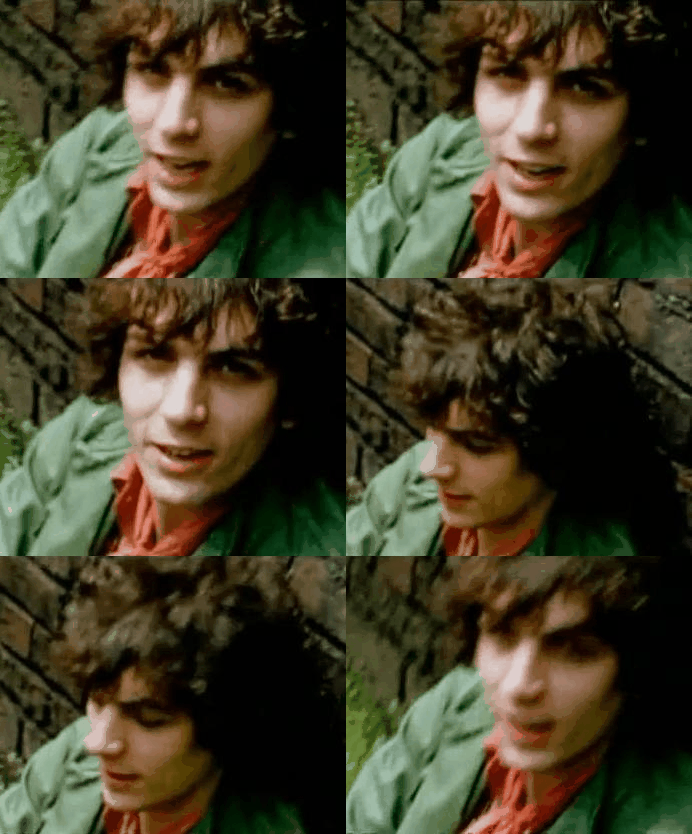
“It’s great doing these songs, because although I didn’t write them, I feel as though they wrote me,” Robyn Hitchcock says in the middle of this two-hour deep dive into the world of Roger “Syd” Barrett, performed shortly after the Pink Floyd founder’s passing. The entire show is a delight, a fitting tribute to the Crazy Diamond; the recording itself is a wonder, too — an audience tape, but crystal clear.
Robyn has plenty of pals to help him out here — the Heavy Friends are both familiar (Morris Windsor, Kimberley Rew, Terry Edwards, Paul Noble) and new (Blur’s Graham Coxon, Belle and Sebastian’s Isobel Campbell, Madness’ Dan Woodgate). It’s celebratory and loose at times, but they’ve definitely rehearsed. There are times during the electric numbers where you might think you’ve traveled back in time to the UFO Club circa 1966. The acoustic stuff, with Campbell adding moody cello, is great, too — Robyn really is the ideal interpreter of Barrett’s songs, reverent, but not too reverent.
My favorite bit here is “Reaction In G,” a Floyd obscurity which Robyn says they haven’t actually heard before. But they find that psychedelic spirit, sending Syd on his way with a noisy, exhilirating freakout.
Robyn Says: I think [Syd] kind of had raw talent. Most people, you know, they’ll have a tube of it, and they’ll squeeze out a little bit, and then they’ll mix in some turps, and they’ll… put a bit of it in. They’ll do an album and there’ll be two great songs that they’ll play forever, and then four not bad songs, and three songs that only their fan club like. They’ll have better and worse albums, and they’ll spread it out like that… But Barrett is like a kid who got hold of a tube of talent, the way that children would get hold of toothpaste – squeeze it all out. Barrett sort of went “Oh yeah,” – out it came. And then there was nothing left.
Tuesday, October 28, 2025
Tuesday, October 01, 2024
Shine on You Crazy Diamond | SYD BARRETT - DARK GLOBE(1970) rare | GUESS I’M DUMB
Syd Barrett - Dark Globe (1970)
"I knew the version on Madcap Laughs, and I’d heard the version on Opel, but this one (released on a bootleg in 1986) is very different from both. The Madcap Laughs track is painful and out of tune at times, whereas this one has “a ghostly and slightly out-of-sync vocal shadowing the main one. That ghostly shadow enhances the woozy mystique of the recording considerably”*
Wednesday, June 19, 2024
David Bowie on the one artist who surpasses all others . . . . . . .
🔴 THE ONE MUSICIAN DAVID BOWIE SAID "DOESN'T HAVE COMPETITION"
The late David Bowie knew good music when he heard it. Drawing on a host of areas to create his distinctive sound, the Londoner utilised the best aspects of other artists over the years, giving him longevity that puts most to shame. This meant that in his time, Bowie touched on glam rock, jazz, industrial and disco to create his classic tracks.
Whilst Bowie didn’t enjoy all forms of music, as he made clear when he discussed his lifelong disdain for country and western, and in his less than courteous treatment of the young newcomer Gary Numan, when Bowie did like someone’s music, the insight with which he imbued his accounts proved to be fascinating.
Throughout his life, Bowie praised many prominent figures, including John Lennon, Syd Barrett and The Velvet Underground, while also touching on more contemporary acts such as Placebo. Yet, for all of the extensive readings of other artists’ work, there was only one he felt that was so brilliant that he “doesn’t have competition”. Of course, this was Bob Dylan, the folk-rock pioneer who has enjoyed more creative endurance than any other.
When speaking to the Dutch music programme Countdown in 1990, Bowie was asked about some of his supposed competitors in music. There, he used Dylan as an example of an act without competition before arguing that The Rolling Stones are in a similar boat. However, his argument was much less assertive about the British band. Bowie: “I would say that I stay out of it, I’d like to say that. Whether that’s true or not, I don’t know. You could tell from the outside. But I don’t really feel that. I feel that frankly, over the last 20 years or so, I’m pretty much my own man. I suppose it’s very cheeky of me to put myself in the same light”.
He added: “But if I look at Bob Dylan, he doesn’t have competition; he is just Bob Dylan. Whether you like him or don’t like him. Whether he does good stuff or bad stuff, he is still Bob Dylan.” “You don’t compare him with anybody. It’s not a competitive kind of thing,” Bowie continued. “It’s the same with The Stones. I know they create mock competitions for them with other bands. I’ve noticed in America, it’s been happening. But there is really no way that you can compare The Stones with anybody. And I would hope, I think, I’m probably in the same kind of position. I’m David Bowie, I’m either good, (or) a pile of shit. I’m accessible or not accessible, obscure, very commercial. I changed all the time. But I’m still me… no? (laughs)”.
Tuesday, January 09, 2024
The Real Ziggy Stardust who Lost his Career to Acid by LIAM WARD | MESSY NESSY
A great article here from the always dependable Messy-Nessy on Vince Taylor the all too likely inpsiration for Bowie’s Ziggy Stardust . . . . . The Real Ziggy Stardust - Messy Nessy and other acid casualties
"Before Vince Taylor would begin his journey into the realms of the psychedelic wilderness, he’d been born Brian Maurice Holden in Middlesex, England. His family had immigrated to America when Taylor was aged 7. There, he’d witnessed the birth of Rock and Roll. He’d developed a ‘teddy boy’ look; changed his name to Vince after Elvis’s character in Jail House Rock and began to sing in talent shows. He would have limited success until his return to England in 1957 where the appetite for authentic American Rock and Roll was great. Taylor had the accent, the look; he wore tight leather pants and biker boots and stalked London’s Soho clubs looking menacing. What Taylor lacked in vocal talent and musicianship, he made up for in a blistering performance that saw him gyrate and jitterbug all over the stage, rolling on the floor in spasmodic convulsions of rock and roll ecstasy.”
Sunday, December 12, 2021
Robyn Hitchcock & Friends - GAMES FOR MAY 2007 Tribute For Syd Barrett
(Reblogged from doomandgloomfromthetomb)
Monday, October 25, 2021
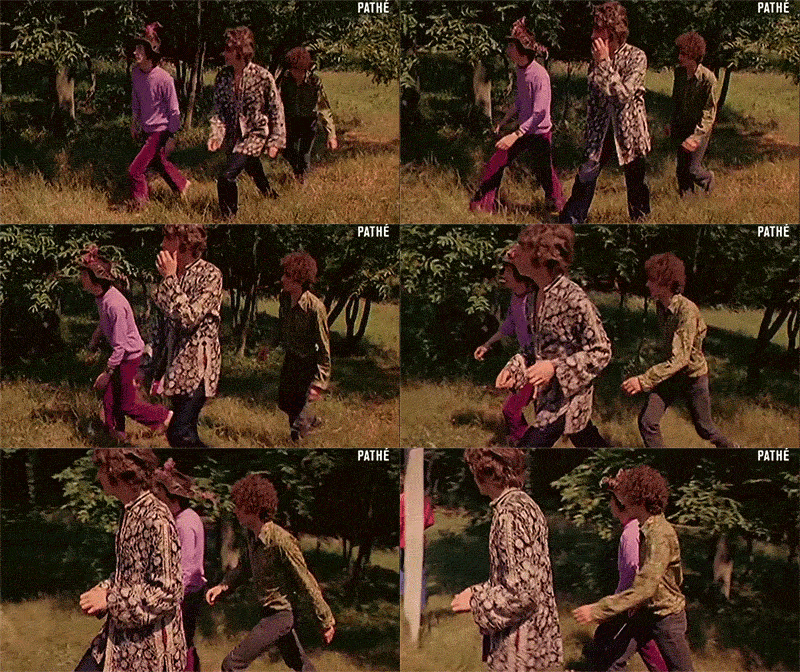
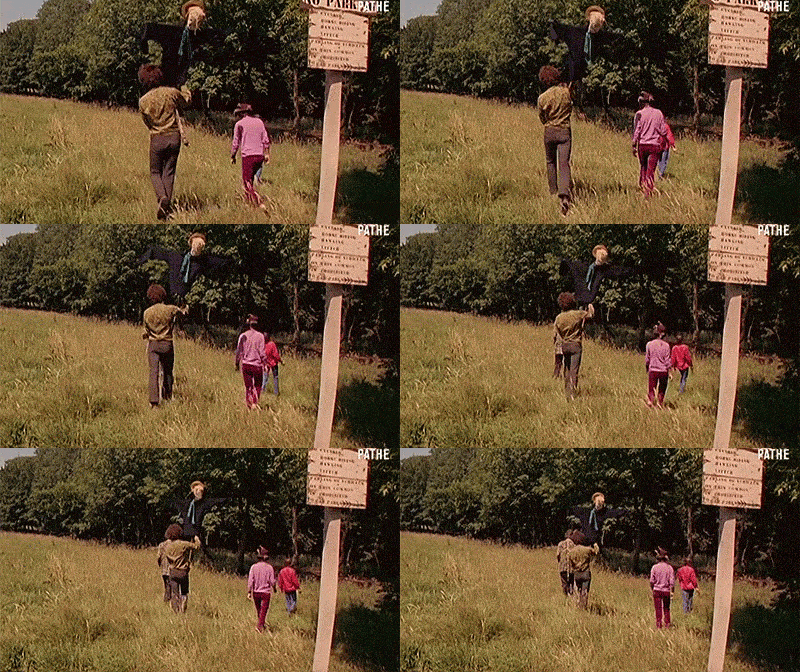
Start the week with Syd and Pink Floyd going to the woods . . . . .
To the Woods? . . . . . . .
No, not to the woods.
To the Woods?
No, NOT to the woods . . . . . . . .
To the Woods?
To the woods . . . . . . . . .
Pow R Toch H
The sweet smell of a great sorrow lies over the landPlumes of smoke rise and merge into the leaden skyA man lies and dreams of green fields and riversBut awakes to a morning with no reason for wakingHe's haunted by the memory of a lost paradiseIn his youth or a dream, he can't be preciseHe's chained forever to a world that's departedIt's not enough, it's not enoughHis blood has frozen and curdled with frightHis knees have trembled and given way in the nightHis hand has weakened at the moment of truthHis step has falteredOne world, one soulTime pass, the river rollAnd he talks to the river of lost love and dedicationAnd silent replies that swirl invitationFlow dark and troubled to an oily seaA grim intimation of what is to beThere's an unceasing wind that blows through this nightAnd there's dust in my eyes, that blinds my sightAnd silence that speaks so much louder than wordsOf promises broken
Thursday, September 13, 2018
I dedicate this, as they did of course, to Syd Barrett
Saturday, July 28, 2018
I have an immense affection for Syd Barrett and his tragic lifestory. I adored the first album I found with him on and it remains a favourite in my top thirty albums for sure in the unique 'The Piper At The Gates of Dawn' [the title taken from a favourite book, Kenneth Grahame's 'The Wind In The Willows' - being the title of the seventh chapter and reference to Pan]. There but for powers and circumstances beyond our control I empathise with Syd's experience and have lost friends to drug use so that I ended up working in the field of rehabilitation of people damaged by such life choices whatever that had propelled them that way.
I have discussed here earlier what happened to later Pink Floyd albums and the time I stopped following the band around the time of 'Dark Side of The Moon' which I found obvious and hollow and the execrable 'The Wall' but Syd's 'Bike' and 'See Emily Play', 'Arnold Layne' 'Lucifer Sam' etc etc still haunt me and I am given to singing 'Bike' at times of stress (if only in my head, fortunately) . . . . . . . shine on you crazy diamond indeed

Thursday, January 11, 2018
Friday, December 22, 2017
![]() |
| Iggy Rose |
Read about her here, this from International Times (and yes it is still going . . . . . . . )
Iggy the Eskimo – The Girl Who Captured the Spirit of the ’60s
Iggy the Eskimo; a friend, a model and a possible love interest of Syd Barrett graced the Swinging London’s Scene in the 1960s. Yet, she vanished from the scene as abruptly as she arrived on it, and her figure remained engulfed in mystery…Iggy the Eskimo was a mysterious figure in the 1960s London Scene for she looked like nobody else at the time. With her long dark hair, lovely Asian features, button nose and baby face, this South-Londoner, whose real name is Evelyn, sprung from the mod scene at the Orchid Ballroom in Purley. Her unusual looks are due to her mother descent; she hailed from the Himalayas. Whiles her looks attracted attention, it was her personality that charmed the London Scene. Iggy was free-spirited, lively, adventurous, not a care in the world; incredible creature, no other word for her.
Iggy gained notoriety by appearing in a newsreel shot at Granny Takes a Trip and in Melody Maker, demonstrating a new dance. Iggy embodied the free spirit of the decade, a true flower power, she lived in the moment, for the moment. Dancing at the Cromwellian Club, shopping at groovy boutiques or walking around wearing an elegant gold lamè 1940s dress, but with no underwear and completely exposed, remembers Duggie Fields.
Soon after meeting Antony Stern, Syd Barrett’s Cambridge friend and a film maker, at Henrix gig at The Speakeasy. Iggy enchanted Anthony and soon became his muse. Stern made a short film of Iggy pirouetting in a London Park. ‘Iggy was terrific fun to be with and to photograph‘, recalled Stern, ‘I remember walking through Battersea Park in the early mornings together. I made a short film of her dancing in Russell Square, the ultimate flower child.‘
Stern also said, ‘Iggy was my muse. I met her at Hendrix gig at the Speakeasy. She was a lovely inspiration andfree spirit. I never knew her real name. We used to hang out together, occasionally dropping acid, staying up all night, going for walks at dawn in Battersea Park. She entirely captures the spirit of the Sixties, living for the moment, completely careless.’
Iggy met Jenny Spires, one of Syd Barrett’s girlfriends, in spring 1967. in fashion store Biba. Iggy admired the dress Jenny was wearing and invited her to a party that night. They went clubbing together. ‘A lovely, sweet, funny girl, always on the scene at gigs and events.‘, recalls Jenny.
Jenny was the one who introduced Iggy to Syd in January 1969, right before she traveled to America. Iggy was homeless at the time and Jenny also wanted Syd to have a companion, so Iggy moved in. Though Syd is now considered to be some kind of dark, mysterious, brooding and secretive poète maudit, this perception of Syd is exaggerated and does not do him justice. Syd was a cheerful character, always ready for a good laugh, not just at a shared joke but sometimes just for the hell of it. Mick Rock, the photographer who shoot the back cover photo for Syd’s debut album The Madcap Laughs, captured this lively and charming Syd while skylarking in Holland Park with Iggy and an unknown brunette. Syd can be seen scampering around in his psychedelic finery, laughing, climbing trees, living the hippie ideal while Iggy is seen playfully running around, wide-smiled as well.
Iggy is perhaps the best memorable for posing on the back cover of The Madcap Laughs. Iggy is seen gracefully and artistically posing completely nude in the background, while Syd crouches in the foreground; an artist in isolation, living in a dark and illusive world of his own, in a world made of dreams and memories, turning his back on reality that is becoming more and more disappointing as days go by. While the cover photo was taken by Storm Thorgerson, the back cover photo was taken by Mick Rock, a friend of Syd who, having started taking pictures only months earlier, still wasn’t sure whether he wanted to be a lyricist or a musician. When Rock arrived that day, Iggy answered the door completely naked; not unusual thing for hippies and students at the time.
Now famous floor, painted in orange and mauve stripes, was painted by Syd and Iggy that morning; Iggy only helping him to finish it more quickly. Iggy was also the one who put kohl around his eyes for that elegantly wasted look. Iggy in the background, painted floorboards and the car outside were just elements that happened to be around; strange coincidences give this album cover a special allure, filled with sadness, nostalgia and a certain magic. But the most striking, most intriguing element of the photos is Iggy. Who was she, many have probably asked themselves, but the mysterious face was anonymous, well, it was until Iggy, or Evelyn, told her story once and for all, pleasing her fans and admirers.
Iggy wasn’t even aware that Syd was a famous psychedelic rock star at the time. Nor did she know that her beautiful bottom graced the back cover art of Syd’s album. She was impressed by his guitar playing but never made a connection between Syd from Earls Court and the face she must have seen at UFO years before. Syd played a tape of the song ‘Terrapin‘ for her once and she considered it to be quite catchy. Iggy didn’t know who he was, Syd, nor anybody else, knew her real name, the wonderful ’60s; good time to be had, tripping on acid, exploring the depths of your mind, that’s what matters, not names, dates or reputation.
Nevertheless, Iggy had vanished from Syd’s life as quickly as she drifted in. There were stories of her marrying a rich banker from Chelsea or joining a religious cult. Nothing of the sort happened. Iggy has been married since 1978. The life she led in Swinging London when the culture, music and fashion were at their peak, is now behind her, but she was reached by The Croydon Guardian reporter after an ex-Cambridge mod Pete Brown sent the magazine a letter saying that he had spent some wild nights with Iggy in the 1970s.
Turns out that Iggy is a daughter of a British army officer and a woman from the Himalayas. Her father had travelled to a remote village in the Himalayas where he met the woman that would become Iggy’s mother. Iggy was born in Pakistan and attended army schools in India and Aden, before the family moved to England. There, Iggy lived at the seaside and attended art school. She was a mod in Brighton and met many ’60s rockers; Keith Richards, Eric Clapton, Brian Jones, Keith Moon, she saw Hendrix make his UK debut at the Bag O’ Nails in November ’66, joined the counter-culture throng in April ’67 in Alexandra Palace for the 14-Hour Tehnicolor Dream, before living with Syd Barrett in Wetherby Mansions and becoming a part of the myth about The Laughing Madcap.
From Byron's Muse
P.S. This page focuses purely on Iggy the Eskimo and her life, so you might want to check it out!
Iggy . . . more here