I Can See You - by Paddy Summerfield c. 1986
Showing posts with label Allen Ginsberg. Show all posts

Friday, May 02, 2025

Other Birthdays - Charley Plymell (90)

(Photo snapped by Allen Ginsberg) 

Neal Cassady & Charley Plymell, in front of the 1403 Gough Street apartment he shared with Allen and Neal that fall of 1963 in San Francisco.  


Charley turns 90 today. Happy Birthday, Charley.  Check out AllenGinsberg.org today for some of his current goings on, new poetry books, & videos from Laki Vazakas.   

Wednesday, August 09, 2023

And The Beat goes on . . . . . . . . . (For JACK KEROUAC)

Some poets . . . .  and their poems 

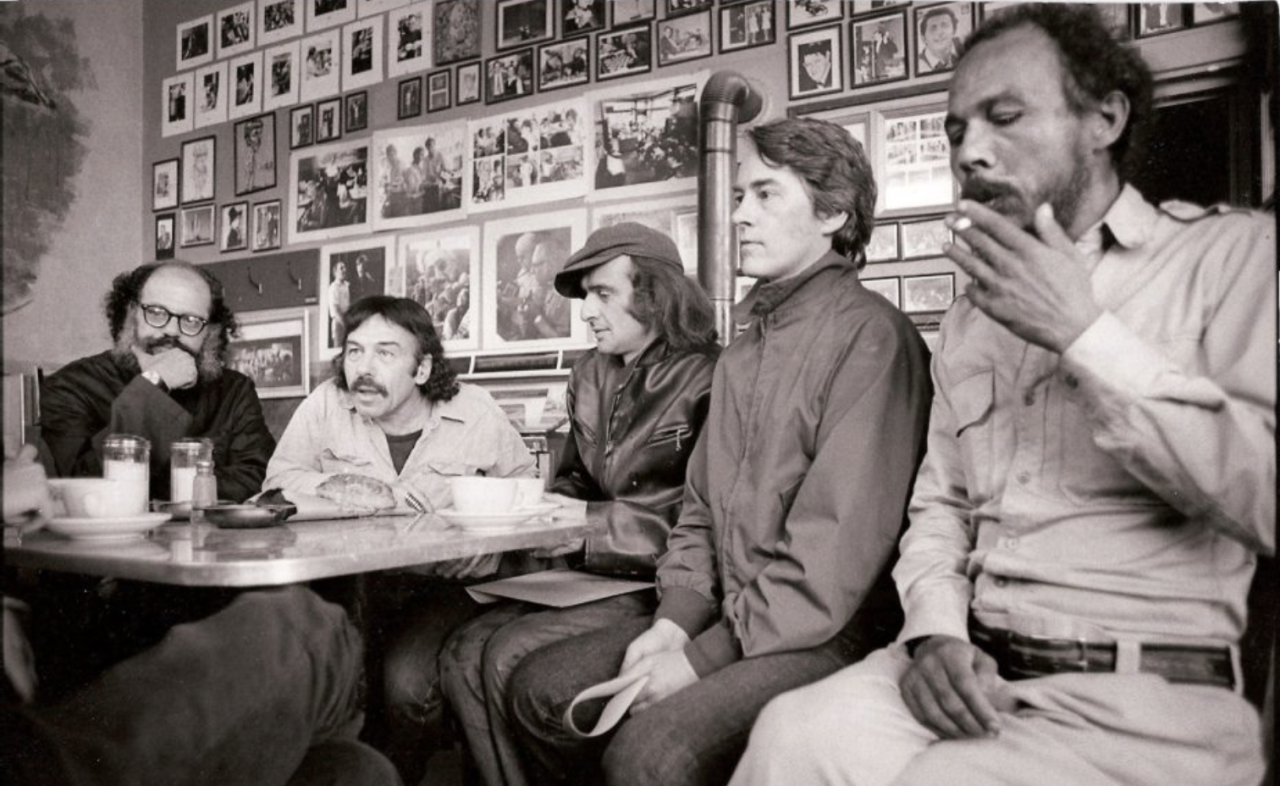
Uncredited Photographer | Beat Poets Allen Ginsberg, Harold Norse, Jack Hirschman, Michael McClure and Bob Kaufman, Cafe Trieste, San Francisco 1975


I walked on the banks of the tincan banana dock and sat down under the huge shade of a Southern Pacific locomotive to look at the sunset over the box house hills and cry.
Jack Kerouac sat beside me on a busted rusty iron pole, companion, we thought the same thoughts of the soul, bleak and blue and sad-eyed, surrounded by the gnarled steel roots of trees of machinery.
The oily water on the river mirrored the red sky, sun sank on top of final Frisco peaks, no fish in that stream, no hermit in those mounts, just ourselves rheumy-eyed and hung-over like old bums on the riverbank, tired and wily.
Look at the Sunflower, he said, there was a dead gray shadow against the sky, big as a man, sitting dry on top of a pile of ancient sawdust—
—I rushed up enchanted—it was my first sunflower, memories of Blake—my visions—Harlem
and Hells of the Eastern rivers, bridges clanking Joes Greasy Sandwiches, dead baby carriages, black treadless tires forgotten and unretreaded, the poem of the riverbank, condoms & pots, steel knives, nothing stainless, only the dank muck and the razor-sharp artifacts passing into the past—
and the gray Sunflower poised against the sunset, crackly bleak and dusty with the smut and smog and smoke of olden locomotives in its eye—
corolla of bleary spikes pushed down and broken like a battered crown, seeds fallen out of its face, soon-to-be-toothless mouth of sunny air, sunrays obliterated on its hairy head like a dried wire spiderweb,
leaves stuck out like arms out of the stem, gestures from the sawdust root, broke pieces of plaster fallen out of the black twigs, a dead fly in its ear,
Unholy battered old thing you were, my sunflower O my soul, I loved you then!
The grime was no man’s grime but death and human locomotives,
all that dress of dust, that veil of darkened railroad skin, that smog of cheek, that eyelid of black mis’ry, that sooty hand or phallus or protuberance of artificial worse-than-dirt—industrial—modern—all that civilization spotting your crazy golden crown—
and those blear thoughts of death and dusty loveless eyes and ends and withered roots below, in the home-pile of sand and sawdust, rubber dollar bills, skin of machinery, the guts and innards of the weeping coughing car, the empty lonely tincans with their rusty tongues alack, what more could I name, the smoked ashes of some cock cigar, the cunts of wheelbarrows and the milky breasts of cars, wornout asses out of chairs & sphincters of dynamos—all these
entangled in your mummied roots—and you there standing before me in the sunset, all your glory in your form!
A perfect beauty of a sunflower! a perfect excellent lovely sunflower existence! a sweet natural eye to the new hip moon, woke up alive and excited grasping in the sunset shadow sunrise golden monthly breeze!
How many flies buzzed round you innocent of your grime, while you cursed the heavens of the railroad and your flower soul?
Poor dead flower? when did you forget you were a flower? when did you look at your skin and decide you were an impotent dirty old locomotive? the ghost of a locomotive? the specter and shade of a once powerful mad American locomotive?
You were never no locomotive, Sunflower, you were a sunflower!
And you Locomotive, you are a locomotive, forget me not!
So I grabbed up the skeleton thick sunflower and stuck it at my side like a scepter,
and deliver my sermon to my soul, and Jack’s soul too, and anyone who’ll listen,
—We’re not our skin of grime, we’re not dread bleak dusty imageless locomotives, we’re golden sunflowers inside, blessed by our own seed & hairy naked accomplishment-bodies growing into mad black formal sunflowers in the sunset, spied on by our own eyes under the shadow of the mad locomotive riverbank sunset Frisco hilly tincan evening sitdown vision.

Allen Ginsberg, “Sunflower Sutra,” 1955


my head felt stabbed

by a crown of thorns but I joked and rode the subway

and ducked into school johns and masturbated

and secretly wrote

                                     of teenage hell

because I was “different”

the first and last of my kind

smothering acute sensations

in swimming pools and locker rooms

addict of lips and genitals

mad for buttocks

                                that Whitman and Lorca

and Catullus and Marlowe

                                          and Michelangelo

and Socrates admired

and I wrote: Friends,

if you wish to survive

I would not recommend

Love


– Harold Norse, “I Would Not Recommend Love” 1973


I ran down the street and into the house smelled
of oregano and shook Mickey Monaco, said
C'mon, Balaban’s got a breadloaf
climbing over old Gruber’s fence, he thinks
the mad dogs is doves.

But Mickey grew up in the bed till he was too old
and besides Balaban was crazy, he sucked
his tongue and got left back twice.

So I ran to Joey Bellino’s house but his mother’s
black stocking said Joey was out early shoe
shining. And besides a, that Balaban he’s a
crazy a kid, he suck a the tongue and Joey says
he get lefback three times.

So I banged on Bitsy Beller’s window yelled he was
near the top, the mad dogs waiting down
below he thinks is doves.

But when Bitsy stood up he turned into a stiff
cue stick. And didn’t want nothing to do
with nobody cracked upstairs.
And Dickie Miller became a semipro. And Howie Fish
a doctor. So I ran down the street full of hope

by myself because I was on fire. But I got there
too late for Balaban. Two of them had a stretch
of skin between their teeth fighting over it,

and the foam of their mouths and Balaban’s blood
spattered in such a way, the most the greatest
picture looked me straight in the eye, made me
sit in the gutter and cry,

and when I got up vow to be
Balaban from that day on

– Jack Hirschman, “Balaban” 1969


for Jack Kerouac 

IN LIGHT ROOM IN DARK HELL IN UMBER IN CHROME,

     I sit feeling the swell of the cloud made about by movement

                 of arm leg and tongue. In reflections of gold

           light. Tints and flashes of gold and amber spearing

                     and glinting. Blur glass…blue Glass,

             black telephone. Matchflame of violet and flesh

                 seen in the clear bright light. It is not night

                and night too. In Hell, there are stars outside.

            And long sounds of cars. Brown shadows on walls

                                       in the light

                           of the room. I sit or stand

                 wanting the huge reality of touch and love.

            In the turned room. Remember the long-ago dream

          of stuffed animals (owl, fox) in a dark shop. Wanting

             only the purity of clean colors and new shapes

                                     and feelings.

                 I WOULD CRY FOR THEM USELESSLY

                   I have ten years left to worship my youth

                      Billy the Kid, Rimbaud, Jean Harlow

  IN DARK HELL IN LIGHT ROOM IN UMBER AND CHROME I

                                                                                            feel the swell of

smoke the drain and flow of motion of exhaustion, the long sounds of cars

                                                                                                     the brown shadows

on the wall. I sit or stand. Caught in the net of glints from corner table to

                                                                                                                       dull plane

from knob to floor, angles of flat light, daggers of beams. Staring at love’s face.

      The telephone in cataleptic light. Marchflames of blue and red seen in the

                                                                                                                            clear grain.

I see myself—ourselves—in Hell without radiance. Reflections that we are.

              The long cars make sounds and brown shadows over the wall.

                               I am real as you are real whom I speak to.

                   I raise my head, see over the edge of my nose. Look up

                    and see that nothing is changed. There is no flash

                            to my eyes. No change to the room.

                       Vita Nuova—No! The dead, dead world.

                     The strain of desire is only a heroic gesture.

                       An agony to be so in pain without release

                             when love is a word or kiss.


– Michael McClure, “The Chamber” 1961


I have folded my sorrows into the mantle of summer night,
Assigning each brief storm its allotted space in time,
Quietly pursuing catastrophic histories buried in my eyes.
And yes, the world is not some unplayed Cosmic Game,
And the sun is still ninety-three million miles from me,
And in the imaginary forest, the shingled hippo becomes the gray unicorn.
No, my traffic is not with addled keepers of yesterday’s disasters,
Seekers of manifest disembowelment on shafts of yesterday’s pains.
Blues come dressed like introspective echoes of a journey.
And yes, I have searched the rooms of the moon on cold summer nights.
And yes, I have refought those unfinished encounters.
      Still, they remain unfinished.
And yes, I have at times wished myself something different.

The tragedies are sung nightly at the funerals of the poet;
The revisited soul is wrapped in the aura of familiarity. 

– Bob Kaufman, “I Have Folded My Sorrows” 1965


Thursday, February 09, 2023

POETRY |at ZERO G| ALLEN GINSBERG - HOWL & OTHER POEMS

 ALLEN GINSBERG

HOWL

AND OTHER POEMS

(feat. Philip Glass, Lenny Kaye, Paul McCartney)

and others

Bob and Allen at Kerouac’s grave 1975

Through a precocious interest in Jack Kerouac, then Ginsberg and Burroughs (I think I have read everything but certainly all the Kerouac and also own most of the Burroughs) I heard the Ginsberg voice through my treasured copy of ‘Howl’ with an early bargain bin album and along with early Brautigan albums and an obsession with trying to find the Beats reading aloud. So there comes these superb examples from Zero G Sounds who lately have posted several and the top one was the ‘Howl’ album but then there is this ‘Ballad of The Skeletons’ too featuring Macca, Philip Glass and Lenny Kaye amongst others which is perhaps surprisingly listenable

If you are interested you could do a whole lot worse than download these. 

Allen Ginsberg ‘Howl and other poems’ 1959 - ZeroGSounds


Allen Ginsberg wrote his epic poem “Howl” in mid-‘50s San Francisco and Berkeley, and the rest is literary history. The work, first read in public in 1955 and published in 1956 before emerging victorious in a 1957 court ruling that it was not obscene, has been hailed as one of the most important poems of the 20th century, and it inspired a wave of Beat poetry.


Allen Ginsberg understood as well as anyone that, in the latter half of the 20th century, rock & roll would be the medium through which poetry and social commentary would reach the young and hungry masses. He eagerly hopped a ride on the bandwagon, collaborating with Dylan, the Clash, and Cornershop; setting William Blake's "Songs of Innocence and Experience" to music; and teaching "Eleanor Rigby" to his English classes at Brooklyn College. The boxed set "Holy Soul Jellyroll" proves that Ginsberg made himself, by sheer force of will, a highly effective though hardly conventional singer/songwriter. Apparently, however, he saved the best for last. 

but there are others too and this links to one worthy of enquiry . . . . . . . . . 

Allen Ginsberg - Lion For Real - ZeroGSounds


Recorded in the late '80s, "The Lion for Real" consists primarily of brief poems set to avant-jazz. Producer Hal Willner has assembled a group that at various times features Marc Ribot, Bill Frisell and Arto Lindsay, and they skillfully navigate the emotional tones and wit in Ginsberg's poems. 

This doesn't contain any of Ginsberg's major works, but it's a welcome reminder of his irascible humour and mischievousness.             

Tracklist:                            
A1
Scribble
A2
Complaint Of The Skeleton To Time
A3
Xmas Gift
A4
To Aunt Rose
A5
The Lion For Real
A6
Refrain
A7
The Shrouded Stranger
A8
Gregory Corso's Story
B1
Cleveland, The Flats
B2
The End
B3
Stanzas: Written At Night In Radio City
B4
Sunset
B5
Hum Bom!
B6
Kral Majales
B7
Guru
B8
Ode To Failure


and Ginsberg reading (singing!) William Blake’s Songs of Innocence


"Songs of Innocence and Experience" is an album by American beat poet and writer Allen Ginsberg, recorded at Apostolic Studios New York City in June & July 1969. For the recording, Ginsberg sang pieces from 18th-century English poet William Blake's illustrated poetry collection of the same name and set them to musical accompaniment, performed with a host of jazz musicians.

Tracklist:

A1a Introduction 2:10
A1b The Shepherd
A2 The Echoing Green 1:22
A3 The Lamb 1:10
A4 The Little Black Boy 3:00
A5 The Blossom 1:22
A6 The Chimney Sweeper 2:20
A7 The Little Boy Lost 1:06
A8a The Little Boy Found 1:24
A8b Laughing Song 1:24
A9 Holy Thursday 1:15
A10 Night 3:57
B1 Introduction 2:06
B2 Nurses Song 2:07
B3 The Sick Rose 1:35
B4 Ah! Sun-Flower 1:12
B5 The Garden Of Love 1:02
B6 London 1:55
B7 The Human Abstract 2:30
B8 To Tirzah 1:42
B9 The Grey Monk 4:06

really worth reading about and checking out for die hard fans

Wednesday, May 06, 2020

MICHAEL McCLURE

October 20, 1932 – May 4, 2020


Another of my great counter culture heroes dies at 87 from complications around a stroke. Michael McClure a great American poet, playwright, songwriter, and novelist. After moving to San Francisco as a young man, he found fame as one of the five poets who read at the famous San Francisco Six Gallery reading in 1955 rendered in barely fictionalized terms in Jack Kerouac's The Dharma Bums when Ginsberg introduced 'Howl'. Friend of Jim Morrison, Bob Dylan, Alan Ginsberg and fellow ‘beats’ he remained staunchly loyal to San Francisco all his life. He more than perhaps anyone did the most to promote Morrison as a bona fide poet rather than a mere lyricist for a 'rock band'. Perhaps most famous for his extraordinary play 'The Beard', the play proved more successful in the UK than anywhere else perhaps and was performed as recently as 2007 in London but is currently out of print. Centred around a dream in which he imagined Jean Harlow undergoes a boxing match with Billy The Kid (sic!) He wrote the humorous ‘Mercedes Benz’ for Janis Joplin amongst a distinct body of poetic work. He leaves his wife the sculptor Amy Evans McClure and a daughter by his first marriage to Joanna McClure


Dylan's Gang - how cool can you be? The legendary shot by the equally legendary Jim Marshall of i-r Robbie Robertson, Michael, Bob, Allen Ginsburg


the young budding poet

Jim and Michael flipping the bird

with fellow writer another hero Richard Brautigan

too cool for skool

MICHAEL McCLURE

Saturday, March 04, 2017


HEY, JACK KEROUAC!


“I would say he [Jack Kerouac]  offered his heart to the United States and the United States rejected his heart. And he realized what suffering the United States was in for, and so the tragedy of America, as (Walt) Whitman had seen the tragedy of the United States. "When the singer of the nation finds that the nation has sickened, what happens to the singer of the nation?” This is Gregory Corso’s question. 

And America, by his day, was sick. Militarily sick. Military-Industrial-Complex had taken over. Hard-heartedness had taken over. Everything that as a Canuck-peasant Kerouac hated had taken over - the mechanization, the impersonality, the homogenization, the money-grabbing, the disrespect for person - that had all taken over. And vast wars - and the attack on the provincial in the wars.  

So I would say America broke his heart.“

Saturday, March 26, 2016

HOWL


Cadets read “Howl”, February 19, 1991, Virginia Military Institute, Lexington, Virginia. 
“I saw the best minds of my generation destroyed by madness, starving hysterical naked, dragging themselves through the negro streets at dawn looking for an angry fix, angelheaded hipsters burning for the ancient heavenly connection to the starry dynamo in the machinery of night, who poverty and tatters and hollow-eyed and high sat up smoking in the supernatural darkness of cold-water flats floating across the tops of cities contemplating jazz” - Allen Ginsberg, Howl
I have a soft cover first edition of Ginsberg's 'Howl' and as a poem it meant and means a  great deal to me. It grabbed me as a youngster and I may have been a teenager when I first read it [1970?]. What I don't understand is quite what these recruits were doing being made to read it in class. Anyone?
I may have said in the previous issues of 'Ways of Seeing' that I wander around the t'internet picking up pictures as I go and apart for the info mentioned I have no idea what is going on here or whose photograph it is. If it is yours and wish a credit just let me know and if you want it taking down please ask me . . . . .