I Can See You - by Paddy Summerfield c. 1986
Showing posts with label Man Ray. Show all posts

Friday, May 15, 2026

Man Ray - on the creative process

 Man Ray on Creativity, Imagination vs Craft


Like much of Marcel Duchamp’s sayings or interviews context is everything but this amused me!

Monday, August 18, 2025

Saturday, May 03, 2025

Dora Maar - picture of the day


Dora Maar by Man Ray

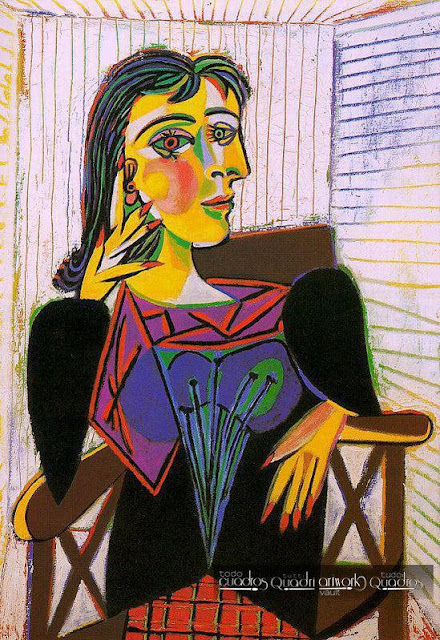
You know how there’s a running gag about Picasso and paintings of women with all their features spread all over and both eyes being on the same side of the head and mouth all askew well it is mostly from Pablo’s paintings of the legendary artist, muse and fine photographer in her own right Dora Maar (see above)
 I think Man Ray is referencing these paintings here with the drawn eye on her hand but what do I know?

Dom Pablo saw her like this


Sunday, August 11, 2024

Photo of the Day : Two Heroes

 Picture of The Day

Two favourite artists

 Man Ray and Marcel Duchamp, Paris, 1968. [Henri Cartier-Bresson]


Wednesday, April 10, 2024

LEE MILLER / MAN RAY (contd.)


Portrait of Lee Miller Asleep by Man Ray. 

I like to think this is true that Man Ray shot this picture of his lover, model and great muse whilst she was in fact asleep. We have mentioned Lee (well both of them) before (and doubtless I will again!) and the great photographic model was also the first woman photojournalist inside Bergen-Belsen and Dachau. 
She may well have suffered what we now call PTSD from her childhood sexual abuse to her experiences of the aftermath of the Holocaust witnessed at first hand. She did not have an easy life adjusting and drank alcoholically to try to cope with the trauma. Many of her photographs inside the death camps have still not been seen as they portray images too horrifying for publication. 
I am proud to have met her and clasped her hand at the ICA Man Ray retrospective with her then husband Sir Roland Penrose. She remains one of my all time heroines. I like to think she is dreaming happily here. 


Monday, March 25, 2024

Man Ray (and Lee Miller)


MAN RAY


“I was very fortunate in starting my career as a painter. When first confronted with a camera, I was very much intimidated. So I decided to investigate. But I maintained the approach of a painter to such a degree that I have been accused of trying to make a photograph look like a painting. I did not have to try, it just turned out that way because of my background and my training… To me, a painter, if not the most useful, is the least harmful member of our society.“ Man Ray


Man Ray     Self-portrait with His Painting “Observatory Time - The Lovers,” Paris      1936 

The lips in the painting are those of his lost lover, Lee Miller.


 “I meet you in the even light and empty space, and, my only reality, kiss you” Man Ray, in a poem to accompany “Observatory Time – The Lovers.”  The lips are those of Lee Miller and the painting/installation was made to commemorate Man Ray’s despair at his breaking off with her.


“I was chasing him.  He looked like a bull with an extraordinary torso and very dark eyebrows and dark hair… If he took your hand or touched you, you felt an almost magnetic heat…

 I said, ‘My name is Lee Miller, and I’m your new student.’ 

Man said, ‘I don’t have students.’ He was leaving for Biarritz the next day, and I said, ‘So am I.’ 

I never looked back!”  Lee Miller, on how she met Man Ray in a Paris bar and became his lover, his muse, his collaborator and his colleague.


“I would rather take a photograph than be one.” Lee Miller 

Monday, May 01, 2023

 ROBERT DESNOS

A journey with SURREALISM


 LEST WE FORGET

The last known photograph of French Surrealist poet Robert Desnos (centre, leaning to his left), taken in the Terezin concentration camp, where he had been sent by the Nazis after having been captured and deported for being an active member of the French anti-fascist resistance.  He had previously been imprisoned in Auschwitz, Buchenwald and Flossenburg concentration camps.  He died from typhoid in Terezín roughly one month after it’s liberation by the Red Army in 1945


Listen to us in your turn, sailors, pilots, soldiers.
We wish you good morning.
We do not speak to you of our suffering but of our hope,
On the threshold of a new day we say good morning,
To you who are near also to you
Who will receive our morning prayer
At the moment when twilight, in straw boots, enters your houses.

And good morning just the same and good morning for tomorrow
And good morning of good heart and all our kin
Good morning, good morning, the sun will rise over Paris
Even if hidden by clouds it will still be there
Good morning, good morning, with all of my heart bonjour.  


– Robert Desnos, from “The Night  Watchman of the Pont-au-Change,” 1942    

(translated by Carolyn Forché)


Desnos - by Man Ray (1922)*

Robert Desnos, (born July 4, 1900, Paris—died June 8, 1945, Terezín, Czech.), French poet who joined the early Surrealist movement, soon becoming one of its most valuable members because of his ability to fall into a hypnotic trance*, under which he could recite his dreams, write, and draw.


Robert Desnos - archives

Wednesday, May 06, 2020

MAN RAY

Man Ray | Ce qui manque à nous tous, 1927, editioned replica 1973


Man Ray | Ce qui manque à nous tous, 1927, editioned replica 1973consists of an inscribed clay pipe and an iridescent glass bubble. Its title, which can be translated as ‘What We All Lack’, does not prescribe the solution to life’s ills, but suggests at least that some part of the answer lies in the childhood pastime of blowing bubbles, in dreaming, and in the pleasure to be taken from evanescent beauty. 

According to Arturo Schwarz, Man Ray’s dealer and author of a monograph on him, the title was derived from a quotation from Engels, one of the founding philosophers of communism, ‘Ce qui manque à tous ces messieurs c’est la dialectique’ (’What these gentlemen lack is dialectic’), reproduced in capitals on the cover of the surrealist group’s magazine, La Révolution surréaliste (Paris, no.8, 1 December 1926). Man Ray told Schwarz, ‘Actually, I had in mind “imagination”, not dialectics, what we all lack is imagination’ (Schwarz, p.209).

The concept of the work dates back to 1927 when the Galerie surréaliste, Paris, announced the making of editions of this and other fantastical objects by several artists. It is questionable whether Man Ray made more than one of the advertised edition of twenty in this period, and it is believed the original prototype was quickly lost. In 1935 Man Ray made a replica that was included in the Exposition surréaliste d’objets held at the Galerie Charles Ratton, Paris, in 1936. According to the catalogue, the work was known as Ce qui nous manque à tous, a slightly different title but one which has the same meaning. The exhibition was accompanied by a theoretical text by the leader of the surrealist movement, André Breton (1896-1966), that described the many types of surrealist object and the ways they ‘perturbed and distorted’ conventional conceptions of reality. In the 1930s the surrealist object was conceived largely in terms of a psychologically charged notion of desire and in the light of the surrealists’ poetical testing of the descriptive role of language. Man Ray’s objects, however, typically expressed a lighter, more playful vision. This object was given life by nothing more substantial than air and the play of light on the iridescent glass surface that, like a photographic lens, can reflect an inverted image of surrounding reality. In contrast to Salvador Dalí (1904-1989), for example, Man Ray did not explore the psychoanalytic roots of personal obsessions and fantasies. His objects were not ‘objects of desire’ but rather, as he said, ‘objects of affection’. 

In 1973 Man Ray authorized an edition of this work (nine examples, plus three trial pieces and three artist’s examples, of which this is one). (The date of 1962 given in the Paris catalogue of Man Ray’s objects in erroneous.) The edition was published by the Galleria Il Fauno, Turin. The title of these works was Ce qui manque à nous tous. The 1935 object had been retained by Charles Ratton after the 1936 show, and was later inherited by his son. It may be that Man Ray changed slightly the title of the work for the edition simply because he did not remember the original title correctly and did not have access to the original piece. 

Lucien Treillard, Man Ray’s assistant in the period, found the pipes (still commonly available in the period) and had made the glass balls for the edition. May Ray inscribed the pieces with the title and date, and signed them with his monogram (letter from Treillard to Tate, dated January 2003). 

Despite Man Ray’s status as one of the pioneering figures of interwar art, his objects are not particularly widely known. This is largely due to his greater fame as a photographer; but it is also in part due to the complex history of many of his objects. A number of the earliest works were lost or accidentally destroyed (the same is true of many of the early classic objects by his friend Marcel Duchamp). Others are known primarily as photographs reproduced in surrealist magazines and their status as objects has been obscured by the celebrity of the photographic images. In fact, Man Ray sometimes made objects in order to photograph them, and then discarded them, or reused them in other ways. He also remade some works, thereby creating new originals, and when, in the 1960s and 1970s, there was a greater commercial interest in the objects, he, like Duchamp, arranged for some of his objects to be produced in editions. 

In addition to Ce qui manque à nous tous, Tate owns a number of other objects by Man Ray. These are New York, 1920, editioned replica 1973 (Tate T07882), L’Enigme d’Isidore Ducasse, 1920, remade 1972 (Tate T07957), Cadeau, 1921, editioned replica 1972 (Tate T07883), Indestructible Object, 1922-3, remade 1933, editioned replica 1965 (Tate T07614), Emak Bakia, 1926, remade 1970 (Tate T07959), and The Lovers 1933, editioned replica 1973 (Tate T07958). 

Further Reading: 
Arturo Schwarz, Man Ray: The Rigour of Imagination, London 1977, p.209 
Man Ray: Objets de mon affection, Paris 1983, pp.143-4 number 39, reproduced p.42 

Jennifer Mundy 

March 2003 
The Tate Gallery

Saturday, October 19, 2019

RANT!

MISATTRIBUTION ON THE INTERNET!

MAN RAY is not MARCUS LEATHERDALE

I don't like Tumblr, I particularly don't like Pinterest, I don't especially like Instagram, I don't like Flickr, I don't really care for Reddit. I have discussed with folk who care that all of these and especially Pinterest can post pictures without copyright or care images by artists and get their facts wrong. Some folk have tried their best to reassure me and help me calm down but it has got worse. It has actually got to the point where people have posted so many versions of an incorrectly attributed image that even websites of academia are getting it wrong and perpetuate the mis-nomenclature! Did they look it up on the internet?!

The picture below is listed ALL over the web as being by Man Ray of his muse and lover Kiki De Montparnasse (real name Alice Prin). Now I studied as an art student alongside the composer Gavin Bryars and the noted historian Fred Orton, the work of Marcel Duchamp and his circle and this required some extensive research into Francis Picabia and others and I became especially interested in the work of Man Ray and did a fair amount of research into his muses from Alice Prin to Adrienne 'Ady' Fidelin and his lover and partner for a time the great photographer Lee Miller (the first photographer into Auschwitz and the first woman there) This picture below is NOT by him, nor is it of Kiki de Montparnasse, it is not even taken in the same era! They are 60 years apart! This has been credited as such now in Sotheby's online sources and people have used it and posted it in academic papers they have published online!

most people credit  as Man Ray 'Kiki De Montparnasse' 1923

It is in fact a picture by the fine art photographer and famous fashion photographer and contemporary of Robert Mapplethorpe, Marcus Leatherdale of a model of his called simply "Larissa" dated 1983 and she is modelling a dress by Issy Miyake the great dress designer from a collection of his work called 'Bodyworks' in the early eighties. For whom this shot was meant to publicise and advertise his work I assume. If, as most sources online would have it, it is dated as 1923 and being of the famous French prostitute turned model, Alice Prin, it is not doing justice either to Issy Miyake, Marcus Leatherdale himself or indeed the model Larissa. It did not take too long to discover the correct attribution but in this lazy scatter culture miasma of chaos we call the internet no-one its seems can be bothered to do any homework at all!


Note Sotheby's have it listed under an article called 'Man Ray: What We Can Learn!' Not much it would seem!

Sad really were it not so inescapably ironic and hilarious! SOTHEBY'S?! FFS!

https://www.sothebysinstitute.com/news-and-events/news/may-ray-what-we-can-learn/


the online fashion (sic?) magazine has it posted as being by Man Ray under the title of an erudite article 'Reality is Elsewhere' Now ain't THAT the truth!


Of the 25,000,000,000 images it drew up on't t'internet are these who IMHO should know better (see below) and of the others posting it thusly I stopped counting at 100 entries on Pinterest but they make up the bulk of the rest . . . . . . 


http://kopenhagen.dk/magasin/magazine-single/article/reality-is-elsewhere/https://arthistoryproject.com/artists/man-ray/kiki-de-montparnasse/

 https://www.dailyartmagazine.com/kiki-de-montparnasse-2/
 http://pictify.saatchigallery.com/1111093/man-ray-kiki-de-montparnasse-1920-trivium-art-history
 https://trippinbox.wordpress.com/2016/09/20/my-muses-1920s-kiki-montparnasse/
 https://www.anatomyfilms.com/man-ray-dada/

N.B. How do I know I am right and not thoroughly mistaken myself you may ask? 


Well it's quite simple I did my research and the shot features in Marcus' book


Larissa in outfit from Issey Miyake’s ‘Bodywork’ collection, A/W 1983-84 | photo Marcus Leatherdale, 1983

or you could ask him!

MARCUS LEATHERDALE WEB

( and while you're about it you might wish to apologise for the misappropriation)


or if you like you could check out his book over at BLURB and you know BUY IT!

Wednesday, February 20, 2019

The Making of Guernica


Dora Maar, Photos of  Pablo Picasso’s Guernica in progress
Executed in between May 4 and June 10, 1937, in Picasso’s Left Bank studio on the Rue des Grands Augustins. Picasso’s progress on the painting was documented by his then-lover, artist and photographer Dora Maar. Maar was a formidable talent in her own right and deserved of much more attention. Muse certainly but also independent artist, painter, poet and photographer (she once shared a studio with Brassai) who documented much of the era as well as exploring her own deep creativity.


Dora Maar in her studio 1946 by Brassai

Dora Maar in her studio with her portrait of Gertrude Stein's partner Alice B Toklas

 
Dora Maar portrait by Man Ray

Friday, January 25, 2019

DALI and MAN RAY


Salvador Dalí and Man Ray in Paris, on June 16, 1934 making “wild eyes” for photographer Carl Van Vechten(…) When Moreau’s liberal teaching methods were later praised by his more radical students, such as Matisse, Breton chastised their inability to see him also as “a great visionary and magician.” The issue of “vision” was taken in a primal sense in Surrealism, since only the “wild eye” of the visionary could see into the abyss. Indeed, one of Breton’s central criteria for painting was that it be a “way of thought directed entirely toward the inner life.” This was a thin paraphrase of Moreau’s own statement about art. Yet interiority had to reveal itself in nonliteral ways. Many artists who apparently painted internal fantasies, such as Swiss painter Arnold Bocklin(1827-1901), were provocative but finally too direct, too literary in their symbols. (…)

Thursday, November 08, 2018

ALICE PRIN

or

KIKI DE MONTPARNASSE


“The most memorable image is Man Ray’s photograph Le Violon D'Ingres, which shows a naked Kiki, seated and viewed from behind, with two ‘f’s in her back; a celebration of her violin-curves, and a statement that she was, in effect, an instrument for the creation of art.
Kiki and Man Ray were lovers for six years, during which time he made hundreds of images of her, and was hugely influential in the creation of her persona. Kay Boyle, a Paris-based American novelist and contemporary of Kiki’s, wrote that, “Man Ray had designed Kiki’s face for her … and painted it on with his own hand. He would begin by shaving her eyebrows off … and then putting other eyebrows back, in any colour he might have selected for her mask that day … Her heavy eyelids might be done in copper one day and in royal blue another, or else in silver or jade.”
Despite their intense connection, Kiki ultimately went too far for Man Ray. When a cafe-owner in Nice called her a whore, she got into a fight, and was thrown into jail: Man Ray’s lawyer could only secure her release by producing a doctor’s certificate stating that she had a nervous disorder. Soon afterwards, Man Ray left Kiki for his photographic protege, Lee Miller. He broke the news to Kiki at one of their regular cafe haunts, and was forced to duck under a table while she hurled plates at his head.” – Anna Davis, The Guardian
(photos: man ray)

“All I need is an onion, a bit of bread, a bottle of red, and I will always find somebody to offer me that.”  – Alice Prin (Kiki de Montparnasse)
(painting: kees van dongen)

Kiki - Man Ray

Kiki De Montparnasse - Man Ray


Wednesday, November 07, 2018

MARCEL DUCHAMP

I may have mentioned that I studied Duchamp at college in a study group organised by Leicester Poly ' Fine Art department tutors, composer Gavin Bryars and historian Fred Orton. Those studies introduced me to a life long interest in Dada and Surrealism, alongside Marcel Duchamp, Man Ray, Francis Picabia and fellow artists of the period especially and a connection to fellow aficionado of Duchamp and reconstructor of the 'Large Glass' Richard Hamilton, the noted father of British Pop Art on whom I did my final thesis and interviewed him at length and got to meet him and his lovely partner fellow artist Rita Donagh many times and this connection with Leicester probably got me my job at MOMA Oxford for over ten years in the late seventies and eighties

Nude Descending a Staircase, No. 2Nu descendant un escalier n° 2) is a 1912 painting by Marcel Duchamp and is considered one of his seminal and most important early works. More broadly the work is widely regarded as a Modernist classic and has become one of the most famous of its time. Before its first presentation at the 1912 Salon des Indépendants in Paris it was rejected by the Cubists as being too Futurist.
The hanging committee objected to the work, on the grounds that it had “too much of a literary title”, and that “one doesn’t paint a nude descending a staircase, that’s ridiculous… a nude should be respected." Duchamp’s brothers, Jacques Villon and Raymond Duchamp-Villon, sent by the hanging committee, asked him to voluntarily withdraw the painting, or paint over the title and rename it something else.


But I went immediately to the show and took my painting home in a taxi. It was really a turning point in my life, I can assure you. I saw that I would not be very much interested in groups after that.” – Marcel Duchamp

Monday, May 07, 2018

I had been thinking about artists I studied at college, Marcel Duchamp, Francis Picabia, Man Ray & Lee Miller and her role in their relationship and how they all fitted with in Surrealism and Dada and finding new and important images about their work as I wandered around the internet. Here an early photograph of Man Ray in his studio:


Man Ray, Self-Portrait in his room-studio, Brooklyn, ca 1910
[the portrait on the easel is one of Sam Ray, his brother and on the wall an early portrait by Man Ray of a fellow student (1909) - see here...]

from: Billy Klüver, Julie Martin, “Kiki et Montparnasse - 1900-1930” (Flammarion, 1989)